The Lanier Law Firm has put together a guide about the connection between the trucking industry and human trafficking. We have included information about why human trafficking is prevalent in trucking, how are people victimized, and the signs all of us can look out for. Check it out:
Practicing gratitude regularly has been shown to increase positive emotions and improve well-being. “Three good things” is a classic gratitude exercise in which participants write down three good things from their day, whether big or small. My favorite Daily Journal Template incorporates this exercise both morning and evening, and only takes 5 minutes. Try it for a week and see what you notice!
Date:
Morning –
I am grateful for:
What would make today great (things within your control):
Affirmations/Intentions/Mantras for today:
Evening –
Three positive things that happened today:
How I could have made today even better/What I will try tomorrow:
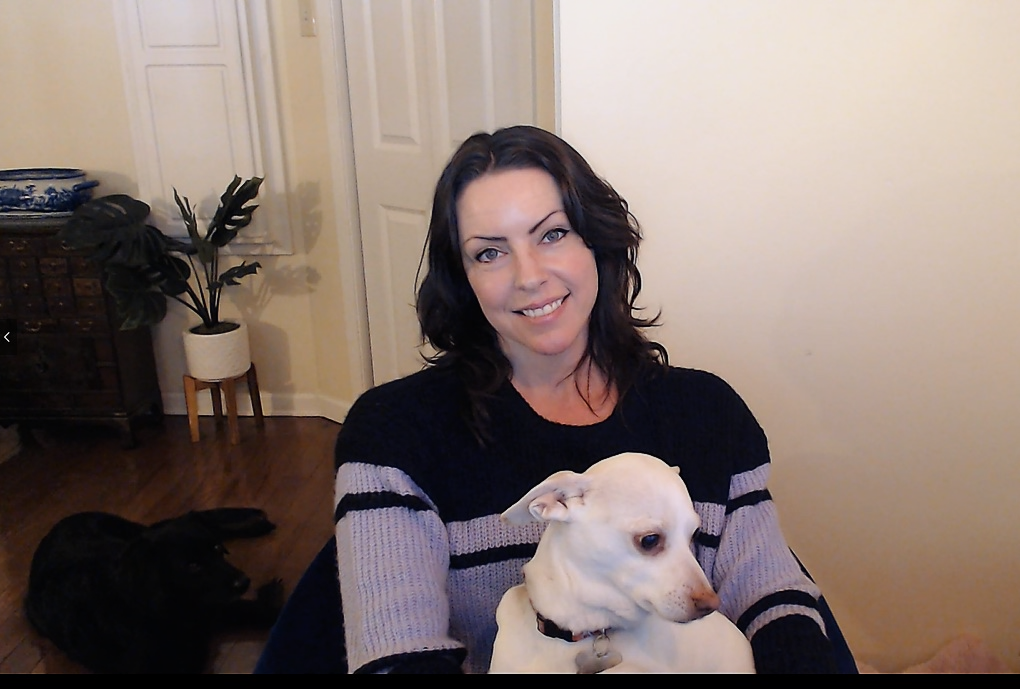
My goldador, Bella (left), and my chihuahua-mix, Rex
In addition to the endorphin-boosting cameos my dogs make, there are many advantages to teletherapy. Two recent studies (in 2019 and in 2021) found that in most cases, therapy via phone and video is just as effective as in-person therapy for treating depression, anxiety, and PTSD. Teletherapy also offers some benefits that in-person therapy does not, including:
Flexibility. You can attend therapy wherever is convenient for you, so long as it is private and you can give your undivided attention.
Ease of Access. You can attend telehealth sessions without worrying about traveling, meaning you can schedule less time per session and can attend therapy during inclement weather or illness.
Lower cost. You don’t have the added costs of transportation, time off work, and childcare that you might for in-person appointments. You are more likely to be able to keep scheduled appointments and not be charged cancellation/no-show fees.
Consistency. Telehealth makes it easier for both clients and therapists to balance their work and personal lives. This allows therapists to see clients more efficiently so you can receive care more consistently.
Efficiency. Paperwork, therapeutic homework, and record transfers can be done electronically and take up less face-to-face time. This can help you stay on track and accomplish your goals in fewer sessions.
Comfort. Being in a familiar environment can help you feel more comfortable opening up about your issues. You don’t have to worry about being seen entering or exiting your therapist’s office, and you can come as you are- with your sweats on, your pet by your side, and a warm cup of tea in hand!
Ready to Get Started?
To get a feel for the platform I use for video sessions, select “Client Portal” from the menu at the top of the page. If you’re interested in live chat sessions, visit betterhelp.com/renee-gaubert. I can explain how to log in and use any features on the telehealth platforms. If telehealth is not a good fit for you, I will recommend a different option and provide appropriate referrals.
I am a licensed clinical social worker (LCSW) and New Orleans has always been my home. I witnessed the devastation and aftermath of Hurricane Katrina as a college student, which moved me forward on a path to understanding the intersection of collective trauma and personal trauma. As I earned my BA from Loyola University in sociology with minors in women’s studies and Spanish, I engaged in feminist activism to raise awareness of sexual violence and was a featured speaker at Take Back the Night. After earning my MSW from Tulane University, I became a domestic violence victim advocate and counselor for the Orleans Parish DA’s Office. I later worked as a community-based mental health professional at Children’s Bureau before receiving my LCSW from the Louisiana State Board of Social Work Examiners and entering private practice. My entire professional background is in trauma work, specializing in working with children and women who have survived physical and sexual abuse. Integrating my experience, education, and clinical training has allowed me to cultivate post-traumatic growth through the therapeutic relationship.
My treatment approach is trauma-informed and oriented in relational cultural theory (RCT). I strongly uphold the core values of social work and see growth-fostering relationships as a source of empowerment. I use an integrative psychotherapy model rooted in cognitive behavioral therapy (CBT) and tailored to the strengths and needs of each client. I bring my years of education and training, professional experience, personal experience, and genuine empathy to build a brave therapeutic space with you, so you can experience a deeper connection with yourself, others, and the world around you.
Built on a foundation of feminism and multiculturalism, RCT promotes intersectionality and social justice. While CBT provides therapeutic techniques, RCT provides a theory as to how individuals experience emotional distress due to unhealthy relational and cultural images. By “images,” we mean internal schemas or beliefs about an individual’s relationships and social identity. The basic tenet of RCT is that disconnection is the source of emotional distress and connection is the source of health, healing, and wellness. RCT posits context as paramount, bringing the social issues of power, freedom, and oppression into the therapeutic space. RCT helps develop insight into one’s relational and cultural images by processing past experiences, and CBT provides structured action steps we can take to promote change in the present. RCT helps identify relational images, which create and reinforce negative core beliefs that can be challenged in CBT. In other words, CBT guides us in identifying and changing what our deepest held beliefs are that are holding us back from the connection we deserve. RCT guides us in understanding how our past experiences shaped those beliefs, and how our present and future experiences can manifest alternative beliefs. By integrating the two, the therapist can validate disconnections before beginning restructuring. All the while, the therapeutic relationship itself creates a new relational image. Clients internalize that they are worthy of transformative connection.
Establishing and fostering safety is crucial to the therapeutic relationship and, in turn, crucial to therapeutic success. By being transparent and authentic in the therapeutic relationship, I hope to create new relational images and thereby reinforce new, adaptive core beliefs. This integrative psychotherapy model provides space for insight while emphasizing coping skills. I have found that through the lens of RCT, techniques from many other forms of therapy such as cognitive processing therapy (CPT), dialectical behavioral therapy (DBT), existential therapy, attachment therapy, narrative therapy, solution-focused therapy, acceptance and commitment therapy (ACT), EMDR, and bibliotherapy integrate with CBT quite effortlessly and effectively. This promotes endless opportunities for growth and connection, and a coping skill set as unique and powerful as the client who employs it.
References:
Comstock, D.L., Hammer, T.R., Strentzsch, J., Cannon, K., Parsons, J. and II, G.S. (2008), Relational-Cultural Theory: A Framework for Bridging Relational, Multicultural, and Social Justice Competencies. Journal of Counseling & Development, 86: 279-287.
Enns, C. Z. (2004). Feminist theories and feminist psychotherapies: Origins, themes, and diversity (2nd ed.). Haworth Press.
Jordan, J. V. (2010). Relational–cultural therapy. American Psychological
Miller, J. B. (1976). Toward a new psychology of women. Boston: Beacon Press.
Since the start of the COVID-19 pandemic, our environments have been in flux in many challenging ways. Our daily routines, plans for the future, interpersonal relationships, and sense of self have all been destabilized. I am available to help ground you during this time, providing confidential therapeutic sessions from the privacy of your own home. I specialize in treating anxiety and depression, particularly in response to traumatic experiences. I offer individual psychotherapy sessions, as well as yoga and dance instruction. I also provide live counseling sessions through BetterHelp. Click here to read testimonials from clients I’ve worked with on that platform. Wellness is dynamic, and I would be honored to help you move forward. To book a session or for more information, click here or fill out the form below:
New federal regulations implementing the No Surprises Act (enacted by Congress in 2020) went into effect on January 1, 2022. The aim of the law is to protect consumers from unanticipated medical bills. There are three (3) parts to the regulations that were developed by multiple federal agencies including the US Department of Health and Human Services (HHS).
Part II requires all health care providers, including clinical social workers (CSWs) and health care facilities licensed, certified or approved by the state to provide good faith estimates (GFEs) of expected charges for services and items offered to uninsured (e.g., not enrolled in any health plan) and self-pay (e.g., not planning to file a claim with their plan) consumers. Effective January 1, 2022, any health care provider or health care facility subject to state licensure must provide a GFE of expected charges for services and items within specific timeframes to current/established and future patients. These new regulations set forth specific requirements for how providers need to inform patients of their right to a GFE, what these good faith estimates must contain and how records are to be maintained. Part II of the regulations also establishes a process for consumers to dispute provider charges that “substantially exceed” a good faith estimate. (“Substantial” is defined as $400 or more). GFEs do not need to be provided to patients who are enrolled in federal health insurance plans (e.g., Medicare, Medicaid, TRICARE, Indian Health Service or the Veterans Affairs health system).
Providing a GFE to patients is not new to CSWs who, as part of best clinical and ethical practice, routinely discuss services and fees before or during the initial interview with new patients and provide informed consent forms. However, the new federal rule formalizes this process and it is now a matter of federal regulatory compliance.
“No Surprises Act” requires practitioners to provide a “Good Faith Estimate” to individuals who are uninsured or utilize self-pay. The Good Faith Estimate (referred to throughout this document as “GFE”) works to show the cost of items and services that are reasonably expected for your health care needs for service, a diagnosis, and a reason for mental health services. The estimate is based on information known at the time the estimate was created. The GFE does not include any unknown or unexpected costs that may arise during treatment. You could be charged more if complications or special circumstances occur and will be provided a new GFE should this occur. If this happens, federal law allows you to dispute (appeal) the bill if you and your provider have not previously talked about the change and you have not been given an updated GFE.
Clinical social workers have always shown the exact costs of services before payment, as our licensing boards require fees to be included in Informed Consent. At or before the time of your first appointment, you will complete a fee agreement with your therapist. Any changes to fees will require a new fee agreement to be signed before the changes takes effect. As the purpose of the bill is to prevent surprise out of pocket costs, we are not the intended use case for this legislation.
The Clinical Social Work Association is working on two fronts to get LCSWs exempted from the GFE. One is a letter co-written with the Psychotherapy Action Network. The other is a campaign to let members of Congress know about the fact that LCSWs in private practice do not need to be part of the GFE; we already do everything that it requires and there are vanishingly low numbers of LCSWs who have had actionable complaints filed against them for surprise billing.
At this time, Renée Gaubert, LCSW is complying with this federal regulation by providing all clients with GFEs as per the current requirements discussed above.
Billing Codes & Fees
I use an electronic health record (EHR) that uses the Current Procedural Terminology (CPT) codes that the GFE requires.
Individualized Treatment
Every individual’s therapy journey is unique and personalized. How long you need to engage in mental health services and how often you attend sessions will be influenced by many factors, including, but not limited to:
Your schedule and life circumstances
Your therapist’s availability
Ongoing life challenges
The nature of your specific challenges and how you address them
Personal finances
You and your therapist will continually assess the appropriate frequency of services and will work together to determine when you have met your goals and are ready for discharge, or to adjust your treatment plan if your goals change. You can also choose to stop therapy at any time. For these reasons, your GFE may include the cost of a single session up to 104 sessions per year.
Good Faith Estimate Disclaimer
As a client of Renée Gaubert, LCSW, you are entitled to receive a Good Faith Estimate of what the charges could be for clinical social work/psychotherapy services provided to you. While it is not possible for a clinical social worker to know, in advance, how many psychotherapy sessions may be necessary or appropriate for a given person, this form provides an estimate of the cost of services provided. Your total cost of services will depend upon the number of psychotherapy sessions you attend, your individual circumstances, and the type and amount of services that are provided to you.
This Good Faith Estimate shows the costs of items and services that are reasonably expected for your health care needs for an item or service.
This estimate is not a contract and does not obligate you to obtain any services from the provider listed, nor does it include any services rendered to you that are not identified here.
The estimate is based on information known at the time the estimate was created. The Good Faith Estimate does not include any unknown or unexpected costs that may arise during treatment. There may be additional items or services I may recommend as part of your care that must be scheduled or requested separately and are not reflected in this Good Faith Estimate. You could be charged more if complications or special circumstances occur. If this happens, federal law allows you to dispute (appeal) the bill.
You have the right to initiate a dispute resolution process if the actual amount charged to you substantially exceeds the estimated charges stated in your Good Faith Estimate (which means $400 or more beyond the estimated charges). You may contact the health care provider or facility listed to let them know the billed charges are higher than the Good Faith Estimate. You can ask them to update the bill to match the Good Faith Estimate, ask to negotiate the bill, or ask if there is financial assistance available. You may also start a dispute resolution process with the U.S. Department of Health and Human Services (HHS). If you choose to use the dispute resolution process, you must start the dispute process within 120 calendar days (about 4 months) of the date on the original bill.
There is a $25 fee to use the dispute process. If the agency reviewing your dispute agrees with you, you will have to pay the price on this Good Faith Estimate. If the agency disagrees with you and agrees with the health care provider or facility, you will have to pay the higher amount.
Renée Gaubert, LCSW assumes no responsibility or liability for the professional ability, reputation, or quality of services provided by the entities or individuals listed above. Inclusion on this list does not constitute an endorsement by Renée Gaubert, LCSW . The order does not imply any ranking or evaluation. Renée Gaubert, LCSW cannot vouch for the contact information’s accuracy; If you discover any inaccuracies in the contact information, please email me at renee.gaubert.lcsw@gmail.com so I can update it. Last updated 2/29/26.
Lately our environments have been in flux in many challenging ways. Our daily routines, plans for the future, interpersonal relationships, and sense of self have all been destabilized. I am available to help ground you during this time, providing confidential therapeutic sessions from the privacy of your own home. I specialize in treating anxiety and depression, particularly in response to traumatic experiences. I offer individual psychotherapy sessions, as well as yoga and dance instruction on a sliding scale. I also provide live video, phone, and chat counseling sessions through BetterHelp. Wellness is dynamic, and I would be honored to help you move forward. To book a session or for more information, fill out the form below:










 Renée Gaubert, LCSW
You must be logged in to post a comment.